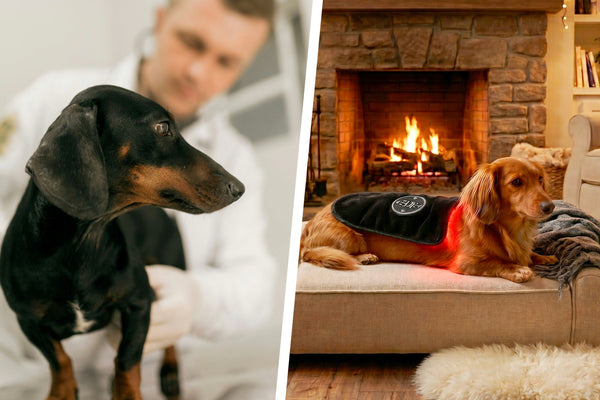
This is one of those topics where it's worth being direct from the start: there is no published research directly testing red light therapy on canine anxiety. That doesn't automatically mean it can't help — but it does mean any claim you read about it "calming anxious dogs" is an extrapolation, not a finding. This guide lays out what the actual evidence base looks like, where it comes from, and how to think about trying it at home in a low-risk, honest way.
What Does "Anxiety" Look Like in Dogs?
Canine anxiety covers a range of presentations. Some dogs are anxious in specific, situational contexts — thunderstorms, fireworks, vet visits, car rides. Others experience more persistent patterns, like separation anxiety or generalized anxiety that shows up across many situations. The distinction matters here: milder, situational stress is where an at-home comfort routine might reasonably fit, while more persistent or severe anxiety is a behavioral health issue that benefits from professional guidance, not just a wellness gadget.
Is There Direct Research on Red Light Therapy for Dog Anxiety?
No — and it's worth saying that plainly rather than working around it. A search of the veterinary and photobiomodulation literature does not turn up controlled studies testing red light or near-infrared light therapy specifically on anxiety, stress hormones, or fear-related behavior in dogs. The existing veterinary PBM research focuses almost entirely on pain, inflammation, wound healing, and joint conditions — not behavioral or emotional states. Anything claiming otherwise is not citing a real study, because one doesn't currently exist in the published literature.
What About the Human Research on Light Therapy and Anxiety?
Where the "light therapy helps anxiety" idea comes from is human research — but it's a meaningfully different application. Human studies use transcranial photobiomodulation (tPBM): near-infrared light applied specifically to the head, aimed at affecting brain tissue directly, not general skin or body exposure. Schiffer et al. (2009) conducted a small pilot study applying near-infrared light to the forehead in patients with depression and anxiety, reporting psychological improvements at two and four weeks post-treatment.[1] Hamblin (2016) explains the general PBM mechanism as light absorption by mitochondrial chromophores affecting cellular energy production — a plausible pathway, but one studied at the level of human brain tissue in these anxiety trials, not a full-body LED wrap on a dog.[2]
This is a meaningful gap to hold onto: a consumer LED wrap placed on a dog's body is a different device, a different application site, a different species, and an entirely different research context than a forehead-mounted near-infrared device studied in small human anxiety trials. The mechanism is related, but the specific claim — "this will calm your dog's anxiety" — isn't something either body of research actually demonstrates.
The Pressure and Touch Angle: What Research Actually Exists
This is where the evidence picture is a little more solid, if still limited. Pressure and compression-based calming tools for dogs — like anxiety wraps — have been studied directly. Mathis et al. (2024) conducted a systematic review of compression wraps as an anxiolytic in dogs and identified four studies meeting their criteria. Their conclusion: pressure wraps aren't associated with adverse effects, but the existing evidence for reducing anxiety is limited, and more research is needed before firm conclusions can be drawn.[3]
That's a more honest starting point than most marketing suggests — "limited evidence, no clear harm" rather than "proven to work." It does mean the touch/pressure/massage angle has at least some direct canine research behind it, which is more than can currently be said for the light component.
So What's the Honest Takeaway?
Putting this together: red light therapy itself has no direct research support for dog anxiety, resting mainly on a plausible-but-unproven extension of human brain-focused studies. The massage or vibration component has a thin but real body of canine-specific research, with a cautious "limited evidence, appears safe" conclusion. Combined, a red light and massage routine is reasonably framed as a low-risk, exploratory comfort tool for mild everyday stress — not as a clinically validated anti-anxiety treatment for either component.
When At-Home Tools Aren't Enough
Contact your veterinarian or a veterinary behaviorist if your dog shows:
- Severe separation anxiety (destructive behavior, self-injury, or extreme distress when left alone)
- Panic responses to triggers that don't resolve with time or gentle management
- Any sign of self-harm, such as excessive licking, chewing, or pacing to the point of injury
- Anxiety that is worsening or significantly affecting daily life
These situations call for a structured behavioral plan, and sometimes medication, from a professional — not a wellness routine at home.
A Reasonable Way to Try It at Home
If your dog experiences mild, everyday stress and your vet doesn't have concerns, a sensible approach is to build calm associations before you need them, rather than reaching for a device mid-panic:
- Introduce the routine during a relaxed moment — after a walk, during downtime — so your dog associates it with calm, not stress
- Keep sessions short and let your dog opt out if they seem uncomfortable
- Don't expect it to replace behavioral strategies for anything beyond mild, situational stress
- Track whether your dog actually seems to settle, rather than assuming it's working
The PawMoves Restore Red Light & Massage Wrap for Dogs combines light and a gentle massage function in one wrap, which fits this framing reasonably well — a general comfort tool that may support relaxation as part of a calm routine, not a treatment backed by anxiety-specific research. If your dog's anxiety is more than occasional or mild, talk to your vet before relying on any at-home product.
Frequently Asked Questions
Is there scientific proof that red light therapy calms dogs?
No. There is no published research directly testing red light therapy on dog anxiety. The idea is extrapolated from human brain-focused (transcranial) studies, which use a different application and target than a body-worn LED device on a dog.
Can I use it during a thunderstorm or fireworks?
You can, but don't expect it to work like a fast-acting calming aid. If you try it, introduce the routine during calm moments first so your dog has a positive association before a stressful event, rather than using it for the first time during a panic episode.
Is the massage or vibration function backed by more research than the light?
There's more direct canine research on pressure and compression-based calming tools than on light therapy for anxiety specifically, though that research is still described as limited by the researchers themselves. It's a slightly stronger evidence base, not a proven one.
Should I stop my dog's anxiety medication and try this instead?
No — never adjust or stop a prescribed medication without talking to your veterinarian first. An at-home comfort routine is not a substitute for a veterinary behavioral treatment plan.
Related Reading
- Red Light Therapy for Pets: A Complete Guide to PBM and At-Home Wellness
- Getting Your Dog to Stay Still During Red Light Therapy: 5 Practical Tips
- How to Build a Red Light Therapy Routine Around Your Dog's Day
- Is Red Light Therapy Safe for Pets? What Pet Owners Need to Know
References
-
Schiffer F, Johnston AL, Ravichandran C, Polcari A, Teicher MH, Webb RH, Hamblin MR. Psychological benefits 2 and 4 weeks after a single treatment with near infrared light to the forehead: a pilot study of 10 patients with major depression and anxiety. Behav Brain Funct. 2009 Dec 8;5:46. PMID: 19995444. https://pubmed.ncbi.nlm.nih.gov/19995444/
-
Hamblin MR. Photobiomodulation or low-level laser therapy. J Biophotonics. 2016 Dec;9(11-12):1122–1124. PMID: 27973730. https://pubmed.ncbi.nlm.nih.gov/27973730/
-
Mathis S, Schoolfield S, Gross P, Gruen M, Dorman DC. A Systematic Review of the Efficacy of Compression Wraps as an Anxiolytic in Domesticated Dogs. Animals (Basel). 2024 Nov 28;14(23):3445. PMID: 39682410. https://pubmed.ncbi.nlm.nih.gov/39682410/