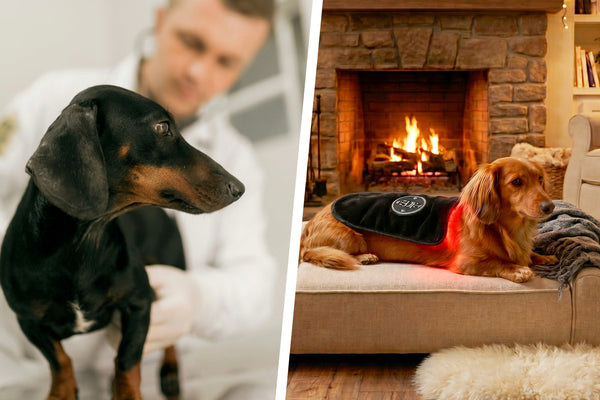
"Best" depends entirely on what you're trying to do. A device that's great for a single sore hip on a calm senior dog might be a poor fit for a wiggly puppy who needs full-body coverage. Rather than crown one winner, this guide breaks down the three device formats on the market in 2026, shows how their specs actually compare side by side, and gives you a quick checklist to apply to anything you're considering — ours included.
The Three Device Formats on the Market
Nearly every pet red light therapy product on the market falls into one of three categories.
Handheld Devices
A wand or panel you hold against your pet's body for the duration of the session. These tend to be compact and often marketed around laser diodes or a small LED cluster.
- Coverage: Small, targeted — you're treating one spot at a time, often just a few minutes per area
- Hands-free: No — someone has to hold it in place for the whole session
- Typical price range: Roughly 250–350
Mat/Pad Devices
A flat panel your pet lies or stands on, or that gets placed against a larger flat area of the body.
- Coverage: Moderate to large, but only where the pet's body makes contact with the flat surface
- Hands-free: Often yes, since the pet can rest on it — but it generally requires your pet to stay in one position
- Typical price range: Roughly 100–150
Wrap/Wearable Devices
A flexible wrap or strap-on device worn around a body part or the torso.
- Coverage: Can range from targeted to full-body, depending on the wrap's design
- Hands-free: Yes — once secured, your pet can move around somewhat or settle in without anyone holding anything
- Typical price range: Varies widely, roughly 150–300
A Side-by-Side Look at Key Specs
Here's how the core specs compare across products currently on the market, based on publicly listed information. Note: competitor figures reflect publicly available product listings as of 2025 and may have changed since — always confirm current specs directly with the manufacturer before buying.
|
Specification |
PawMoves Restore (Wrap) |
Product A (Handheld) |
Product B (Mat) |
Product C (Handheld) |
|
Wavelengths |
660nm + 850nm |
660nm + 850nm |
660nm + 850nm |
635nm + 850nm |
|
LEDs/Emitters |
148 LEDs (444 emitters) |
5 laser diodes |
Not publicly disclosed |
16 LEDs |
|
Coverage area |
Full-body wrap |
Spot only (~2–3 min/area) |
Targeted area |
~4.7 cm² per session |
|
Intensity levels |
3 adjustable |
3 power modes |
Fixed output |
Fixed (pre-programmed) |
|
Vibration massage |
Included, 6 modes / 19 levels |
Not available |
Not available |
Not available |
|
Hands-free use |
Yes |
No — must hold throughout |
Yes |
No — must hold throughout |
|
Power |
Magnetic cordless, 2000mAh USB-C |
Cordless handheld |
Battery/power bank |
Rechargeable cordless |
|
Auto safety shutoff |
30 min auto-off, 1 min sleep |
No auto-off listed |
Duration undisclosed |
Preset 31s timer |
|
Price (USD) |
$129 |
~297–349 |
~99–149 |
~250–299 |
What These Numbers Actually Mean for Your Dog or Cat
A few of these specs are easy to misread, so it's worth translating them:
LED count isn't the same as effective coverage or strength. More diodes spread over a bigger wrap means more surface area treated per session, not necessarily "more powerful" per square inch. A handheld device with fewer emitters concentrated on one small spot can deliver comparable or higher local intensity — it's just covering far less area per session.
"Must hold throughout" is a bigger deal than it sounds. If your dog won't sit still — a genuinely common problem, as anyone who's tried it knows — a device that requires continuous hand-holding for the full session is much harder to use consistently than something that straps on and stays put.
Fixed output vs. adjustable intensity matters most for smaller or more sensitive pets. A device with only one output level can't be scaled down for a small dog or a cat, whereas adjustable levels let you start conservatively and increase as your pet tolerates it — something we've emphasized throughout our own safety guidance for cats in particular.
An auto-shutoff isn't just a convenience feature. It's a safety backstop for sessions that run longer than intended, especially relevant if your pet tends to fall asleep mid-session.
Where Vibration Massage Fits Into the Decision
Vibration massage isn't a standard feature across this category — most pure light-therapy devices don't include it at all. Whether it matters to you depends on what you're addressing: if your pet's discomfort involves compensatory muscle tension (common with joint issues like hip dysplasia) alongside general inflammation, a combined light-and-massage device addresses both angles rather than just one. If you're only interested in light therapy itself, it's a nice-to-have rather than a deciding factor.
A Quick 2026 Buyer's Checklist
A condensed version of the full criteria (our detailed breakdown covers each of these in depth):
- ✅ Dual wavelengths (660nm + 850nm) rather than a single wavelength
- ✅ Adjustable intensity levels, not just a fixed output
- ✅ An auto-shutoff timer
- ✅ Coverage area that actually matches where your pet needs treatment
- ✅ A form factor your specific pet will tolerate (hands-free wrap vs. handheld you must hold)
- ✅ Transparent specs — be cautious of listings that don't disclose LED count, output, or wavelength clearly
Where PawMoves Restore Fits Into This Comparison
Looking at the table above: the Restore is a wrap-format device with 660nm + 850nm dual wavelengths, 444 emitters spread across a full-body wrap, three adjustable intensity levels, hands-free magnetic cordless wear, a 30-minute auto-shutoff, and an integrated vibration massage function with 19 intensity levels across 6 modes, at $129. Those are the facts as they stand next to the other formats above — whether the wrap format, the added massage function, or the price point is the right combination for your specific dog or cat is a judgment only you can make, ideally after checking the criteria in this guide against whatever you're considering.
Frequently Asked Questions
Is a more expensive device always better?
No. Price often reflects device format and features (like a built-in massage function) more than it reflects therapeutic strength. A higher price doesn't guarantee better wavelengths, adjustable intensity, or safety features — check the actual specs rather than assuming price signals quality.
Does more LEDs mean stronger therapy?
Not necessarily. More LEDs spread across a larger wrap generally means more surface area covered per session, not a stronger dose delivered to any single point. A concentrated handheld device with fewer emitters can deliver comparable intensity to a small area.
Do I need vibration massage, or is light therapy enough?
It depends on what you're addressing. If your pet's discomfort is purely about inflammation or general wellness, light alone may be sufficient. If there's also muscle tension — common with joint conditions where a pet compensates by using other muscles differently — a combined device addresses both.
What's a reasonable price range for a quality device in 2026?
Based on current market listings, functional devices span roughly $100 to $350, with price driven mainly by format (handheld vs. mat vs. wrap) and added features rather than a single "quality" tier. Focus on the spec checklist above rather than price alone.
Related Reading
- How to Choose a Red Light Therapy Device for Your Pet
- Red Light Therapy Mat vs Handheld Device for Pets: Which Works Better?
- Vibration Massage for Dogs: What It Is and Why Vets Use It
- Getting Your Dog to Stay Still During Red Light Therapy: 5 Practical Tips
- Home Red Light Therapy vs Vet Laser Sessions for Dogs: Cost & Convenience
References
This is a consumer buying guide rather than a research-focused article; for the underlying science and mechanism references, see our companion articles: "Red Light Therapy for Pets: A Complete Guide to PBM and At-Home Wellness."
Note: This is written by a brand that sells one of the devices in this category. Rather than pretend to be a neutral third-party review, we're laying out how the different device formats actually compare on paper, using real spec data — so you can judge for yourself, including against products we don't make.