
The market for at-home red light therapy devices has expanded considerably over the past few years. That is broadly good news — it means more pet owners have access to PBM technology without requiring clinic visits. But it also means the range of device quality is wider than ever, and not all products deliver what the science actually supports.
This guide covers the key technical and practical factors that distinguish an effective, well-designed device from one that simply looks the part. Understanding these factors makes it easier to evaluate any product on its actual merits — and to ask the right questions before you buy.
Why Device Quality Varies More Than You Might Expect
Red light therapy is a well-researched field, but the regulatory landscape for wellness devices — as opposed to medical devices — is relatively open. This means that almost any manufacturer can produce and sell a product described as a "red light therapy device" without being held to the specific wavelength accuracy, power density, or safety standards that the research literature is based on.
In practice, this creates a significant gap between devices genuinely built around peer-reviewed PBM parameters and those that use generic red LEDs with little consideration for the science. As Anders et al. (2015) note, even the terminology used in the field — "low-level laser therapy," "photobiomodulation," "red light therapy" — is applied inconsistently across both research and commercial contexts, making it harder for consumers to evaluate products against the evidence base.[3] The difference between a well-specified and a poorly specified device is not always visible from the outside, which is why knowing what to look for matters.
The Most Important Factor: Wavelength Accuracy
Wavelength is the single most important specification to verify in any PBM device. The research underpinning red light therapy is based on specific wavelengths — primarily 660nm (visible red) and 850nm (near-infrared) — because these are the wavelengths absorbed most efficiently by Cytochrome c Oxidase, the mitochondrial photoreceptor at the centre of PBM's cellular mechanism. As Chung et al. (2012) describe, it is this absorption that triggers the downstream photochemical cascade — increased ATP synthesis, modulation of reactive oxygen species, and the cellular signalling effects that make PBM a studied wellness technology rather than a general light exposure.[1]
Wavelengths even 20 to 30nm outside these targets interact differently with biological tissue and may not be absorbed by the same cellular machinery at all. A device emitting light at 630nm or 880nm is not equivalent to one operating at 660nm and 850nm, regardless of how it is marketed.
When evaluating a device, look for:
- Specific wavelength values listed in the product specifications — not just "red light" or "infrared"
- Both 660nm and 850nm wavelengths included, to support both surface and deeper tissue in the same session
- Third-party lab verification of wavelength accuracy, if available — some manufacturers publish spectral output data, which is a meaningful positive indicator
Power Density: Enough to Reach the Tissue
The second key specification is power density — also referred to as irradiance, measured in milliwatts per square centimetre (mW/cm²). This describes how much light energy is delivered to the tissue per unit area, and it has a direct bearing on both effectiveness and safety.
A device with insufficient power density will not deliver enough photons to the target tissue to produce a meaningful cellular response, regardless of session length. Hamblin (2016) notes that both under-dosing and over-dosing are genuine considerations in PBM — the dose-response relationship is non-linear, and operating below the effective threshold produces no useful outcome.[2] Conversely, very high power densities — such as those used in surgical laser applications — move outside the wellness category entirely and are not appropriate for unsupervised home use.
Home-use wellness devices typically operate within a range that is well-studied and appropriate for regular use (roughly 20–50 mW/cm²). The important thing is that a manufacturer is transparent about their device's power output, and that the figure is specific rather than vague. A product listing only LED count or total wattage without specifying irradiance at a given distance is harder to evaluate properly.
It is also worth noting that more LEDs does not automatically mean higher effective power density. LED quality, spacing, and housing design all affect how light is delivered to tissue — which is why raw LED count is a poor proxy for device effectiveness.
Format: The Practical Factor That Determines Daily Use
Beyond the technical specifications, the physical format of a device has a significant practical impact on how consistently it gets used — and consistency is the foundation of effective PBM. Here is how the main formats compare in a pet wellness context.
Handheld Wands
Handheld devices offer flexibility and targeted application, which can be useful for focusing on a specific small area. The practical limitation is that they require continuous manual operation throughout the session, making it harder to maintain consistent coverage over larger areas and more difficult to sustain daily use long-term.
- Best for: Targeted spot use on a specific, small area.
- Limitation: Requires hands-on operation throughout; less practical for full-body or larger-area sessions.
Panels
Panel devices offer a larger treatment area and are generally hands-free once positioned. Most panels are designed primarily for human use — mounted on a stand or hung on a wall, with the user standing or sitting in front of them. This format is less suited to pet use, as it requires the animal to remain stationary at a fixed distance from a vertical surface.
- Best for: Human use; large coverage area for people.
- Limitation: Designed around human posture; less practical for pets who naturally lie down rather than stand facing a panel.
Mat and Wrap Format
Mat and wrap formats are designed around how pets actually rest. The device lies flat or wraps over the animal, delivering light across a broad area while the pet relaxes in their natural position. This format is hands-free, requires no repositioning during a session, and fits naturally into the kind of daily routine that makes consistent use achievable long-term.
- Best for: Daily whole-body wellness sessions; pets of all sizes; owners who want a low-effort, sustainable routine.
- Limitation: Less suited to very precise, isolated spot targeting compared to a handheld device.
Combined Light and Massage Devices
A small number of devices combine red light therapy with a vibration massage function in a single unit. This is worth noting as a distinct format because the two modalities serve complementary roles — light works at the cellular level, while vibration massage supports surface circulation and can assist with the settling process during sessions. For pet owners looking for a single device that covers both, the key consideration is whether the two functions can be used independently as well as together, and whether the massage intensity is adjustable enough to suit different animals and preferences.
- Best for: Owners who want dual-function support without managing two separate devices.
- Limitation: Fewer products in this category; verify that both functions meet the technical specifications above independently.
Safety Certifications: What They Actually Mean
Certification language on pet wellness devices can be genuinely confusing, and it is worth understanding what the key terms actually mean before treating them as a quality signal.
FDA Registered vs. FDA Cleared vs. FDA Approved
These three designations are frequently conflated but mean very different things. FDA Registered simply means that a manufacturing facility has been listed with the FDA — it does not involve any evaluation of the product itself and should not be interpreted as an endorsement of safety or effectiveness. FDA Cleared (via the 510(k) pathway) means the device has been reviewed and found substantially equivalent to an existing legally marketed device. FDA Approved involves the most rigorous review process and is typically reserved for higher-risk medical devices. Most home-use wellness devices are registered at most; very few have been through the cleared or approved pathways.
FCC Certification
FCC certification indicates that an electronic device has been tested and found to comply with the Federal Communications Commission's standards for electromagnetic emissions. For home-use LED devices sold in the US market, FCC certification is a meaningful baseline indicator of manufacturer accountability and product testing — it confirms the device has gone through a regulated review process, even if that process is not specific to therapeutic effectiveness.
CE Marking
CE marking indicates that a product meets European Union safety, health, and environmental requirements. For devices sold in EU and UK markets, this is a meaningful baseline safety indicator, though it does not speak to clinical effectiveness.
What to Look For in Practice
Rather than relying solely on certification badges, look for manufacturers who are transparent about their technical specifications, publish their testing data, and clearly distinguish between what their device is designed to do (wellness support) and what it is not (medical treatment). Transparency in these areas is generally a more reliable quality signal than any single certification.
Questions to Ask Before You Buy
Use this checklist when evaluating any red light therapy device for your pet. A manufacturer confident in their product should be able to answer all of these clearly:
- Does it use both 660nm and 850nm wavelengths? Are these values specified precisely in the product documentation, or described only in general terms such as "red" and "infrared"?
- Is the power density (irradiance) specified? Is it measured at a defined distance from the device? Is it within a range appropriate for home wellness use?
- Is it designed specifically for pets? Or is it a human device being repurposed? Pet-specific design — particularly in format and session guidance — makes a practical difference to daily use.
- Is it confirmed non-thermal and non-UV? These are baseline safety requirements for any home-use PBM wellness device.
- What safety certifications does it hold? FCC certification (for the US market) and CE marking (for EU/UK) are meaningful baseline indicators. Understand what each certification actually covers before treating it as a quality endorsement.
- What are the warranty and return terms? A manufacturer confident in their product's quality will typically offer a reasonable return window and warranty period.
- Does the brand clearly position the device as a wellness tool? Be cautious of products making specific medical or treatment claims. A well-positioned wellness device is honest about what it does and does not do.
The PawMoves Restore: How It Measures Up
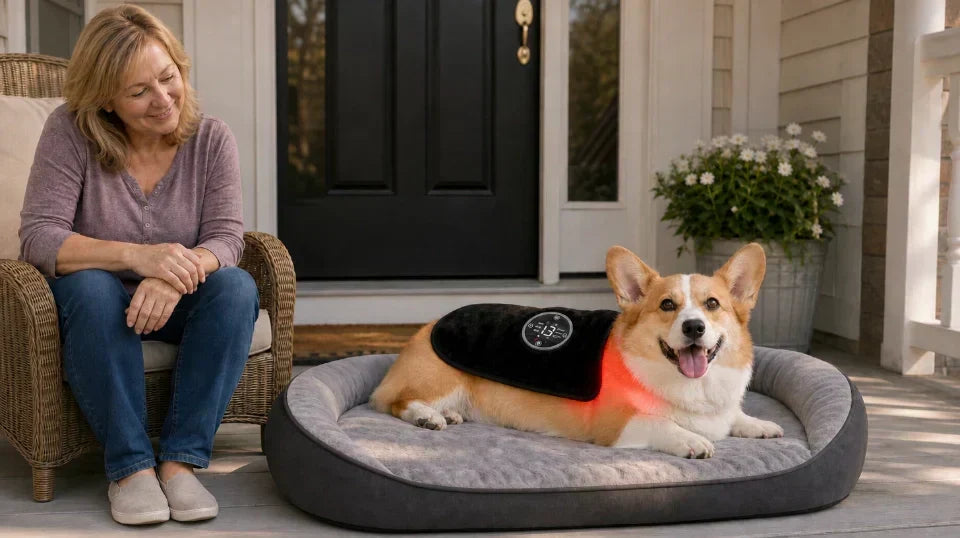
The PawMoves Restore Red Light & Massage Wrap for Pets was built around the specifications that matter. It delivers both 660nm and 850nm wavelengths simultaneously through 444 evenly distributed points of light, with three adjustable intensity levels and a cordless, USB-C fast-charging design.
On format: the wrap sits directly against the body with adjustable securing straps, providing hands-free coverage across the back, hips, and shoulders in a single session — the areas most relevant for a daily wellness routine. The 30-minute auto-shutoff manages session length without manual oversight.
On the combined function: the independent vibration massage system — six modes and 19 intensity levels — can be used separately from the light or layered into the same session. Both functions are independently adjustable, which means you can adapt the session to your pet's preferences rather than working around fixed settings.
On certifications: the Restore holds FCC certification for the US market, confirming it has met the relevant regulatory standards for home-use electronic devices.
Frequently Asked Questions
Is more LEDs always better?
Not necessarily. LED count is one of the most commonly cited figures in product marketing, but it is a poor standalone indicator of effectiveness. What matters is whether the LEDs emit the correct wavelengths, at an appropriate power density, with consistent coverage across the treatment area. A device with fewer, higher-quality LEDs at the right specifications will outperform one with many LEDs at imprecise or ineffective wavelengths.
Does price reflect quality for red light therapy devices?
To a degree, but not reliably. Price reflects a combination of component quality, manufacturing standards, research and development investment, and brand positioning. Very low-cost devices often cut corners on LED quality or wavelength accuracy. However, a high price does not automatically guarantee technical superiority — marketing spend can inflate cost without improving the underlying product. Focus on the specifications rather than the price point.
Can I use a human red light therapy device on my pet?
In principle, the wavelengths involved are the same — 660nm and 850nm light does not distinguish between species. However, human devices are designed around human anatomy and behaviour: panels are built for people to stand in front of, handheld devices are sized for human hands and human-scale sessions. A device designed around how pets rest and move will be easier to use consistently and safely in a pet-specific context. For a full discussion of this topic, see: Can I Use a Human Red Light Therapy Device on My Pet?
How do I know if a device is actually working?
PBM works cumulatively — the cellular effects build over consistent daily use rather than producing an immediate perceptible response. The most reliable indicators are behavioural: how your pet responds to and settles during sessions, and gradual changes in coat condition or general ease of movement observed over several weeks. For a practical guide to tracking progress, see: How to Build a Red Light Therapy Routine Around Your Dog's Day
What is the difference between a wellness device and a medical device?
A wellness device is designed to support general health and daily wellbeing — it is not intended to diagnose, treat, cure, or prevent any specific health condition. A medical device undergoes a different regulatory review process and carries specific clinical indications. At-home PBM devices are wellness devices. This distinction matters both for how you use the device and for the claims a manufacturer is permitted to make about it.
Related Reading
- Red Light Therapy for Pets: A Complete Guide to PBM and At-Home Wellness
- 660nm vs 850nm: What These Two Wavelengths Actually Do for Your Pet
- Is Red Light Therapy Safe for Pets? What Pet Owners Need to Know
- How to Build a Red Light Therapy Routine Around Your Dog's Day
- Can I Use a Human Red Light Therapy Device on My Pet?
References
- Chung H, Dai T, Sharma SK, et al. The nuts and bolts of low-level laser (light) therapy. Ann Biomed Eng. 2012 Feb;40(2):516–533. PMID: 22045511. https://pubmed.ncbi.nlm.nih.gov/22045511/
- Hamblin MR. Photobiomodulation or low-level laser therapy. J Biophotonics. 2016 Dec;9(11-12):1122–1124. PMID: 27973730. https://pubmed.ncbi.nlm.nih.gov/27973730/
-
Anders JJ, Lanzafame RJ, Arany PR. Low-level light/laser therapy versus photobiomodulation therapy. Photomed Laser Surg. 2015 Apr;33(4):183–184. PMID: 25844681. https://pubmed.ncbi.nlm.nih.gov/25844681/


