
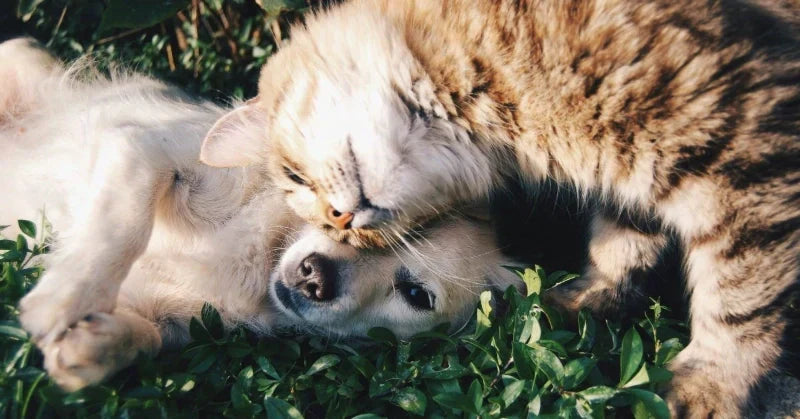
If you already use red light therapy as part of your dog's wellness routine, it is natural to wonder whether your cat might benefit too. The short answer is yes — the cellular mechanism is the same across mammals. But cats are not small dogs, and the practical approach to a PBM session with a cat is different enough that it deserves its own guide.
This article covers the science that applies specifically to cats, the real differences between working with cats and dogs, and a step-by-step approach to building a routine your cat will actually tolerate — and, with time, come to anticipate.
The Science: Why Red Light Therapy Applies to Cats
Photobiomodulation (PBM) works at the mitochondrial level. Specific wavelengths of light — 660nm (visible red) and 850nm (near-infrared) — are absorbed by Cytochrome c Oxidase, an enzyme within the mitochondrial respiratory chain. As Chung et al. (2012) describe, this absorption supports ATP production and modulates downstream cellular signalling through a photochemical process that does not involve heat, ionisation, or physical contact.[1]
This mechanism is not species-specific. Mammalian cells share the same basic mitochondrial architecture — which is why PBM research spans humans, dogs, horses, and cats. Anders et al. (2015) note that the terminology used in the field applies consistently across species: the biology of the photoreceptor does not change, only the practical variables involved in delivering light to the target tissue.[5]
For cats, those practical variables matter more than most guides acknowledge. Understanding them is the starting point for a routine that actually works.
Why Cats Are Underserved in the At-Home PBM Conversation
Most at-home red light therapy content — including most product guidance — is written with dogs in mind. This reflects the market, not the biology.
What is often overlooked is how prevalent musculoskeletal changes are in the feline population. Studies using radiographic imaging have found that over 90% of cats aged 12 and older show evidence of degenerative joint changes — a figure that most cat owners have never encountered because cats are exceptionally good at masking discomfort. Unlike dogs, who tend to show obvious lameness when a joint is bothering them, cats simply become quieter, jump less, groom differently, or spend more time resting. The change is gradual and easy to attribute to "just getting older."
This is relevant for at-home PBM because it means the population of cats who could benefit from a regular wellness routine is considerably larger than is commonly assumed — and because many of those cats' owners are not looking for a condition-specific solution, but simply a proactive daily practice. Hochman (2018) notes in his review of veterinary PBM that cats represent a significantly underserved patient population for photobiomodulation, with the existing research supporting its application across a range of species beyond the dog-centric literature.[4]
How Cats Differ from Dogs: What Actually Changes in Practice
The biology is shared. The practice is not. Here is where the real differences lie.
Coat Type and Light Penetration
Coat characteristics affect how efficiently light reaches the skin surface — and cats vary more widely in coat type than dogs do in the typical pet household. Hochman-Elam et al. (2020) assessed photon transmission across different coat colours and densities in dogs and found that darker pigmentation and greater coat density both reduced light transmission to the underlying tissue.[3] The same physical principles apply to cats.
In practical terms:
|
Coat Type |
Practical Implication |
|
Short, fine single coat (domestic shorthair) |
Light reaches skin surface readily; no adjustment needed |
|
Dense double coat (Maine Coon, Siberian, Norwegian Forest) |
Hold device closer to body; gently part fur for targeted areas |
|
Long single coat (Ragdoll, Turkish Angora) |
Part fur for session; 850nm near-infrared penetrates more reliably than 660nm |
|
Dark pigmentation (black or dark brown coat) |
Expect slightly reduced surface penetration; consider longer sessions |
|
Hairless (Sphynx, Peterbald) |
No coat barrier; start with shorter sessions and lowest intensity setting |
The 850nm near-infrared wavelength penetrates more deeply than 660nm regardless of coat type, which is why dual-wavelength devices are the most practical choice for cats with varying coat characteristics.
Body Size and Session Coverage
Most domestic cats weigh between 3.5 and 5.5 kg — considerably less than the average dog. This has two practical implications. First, the relative coverage area per session is larger — a device that covers a dog's lower back covers a proportionally greater surface area on a cat. Second, the tissue volume being supported per session is smaller, which means shorter sessions can still be effective.
A useful working principle: for cats, start with sessions roughly half the length you might use for a medium-sized dog, and build from there based on your cat's comfort.
Temperament: The Most Significant Practical Difference
This is where cats diverge most clearly from dogs — and where most first-time attempts at a cat PBM routine go wrong.
Dogs are generally accustomed to directed handling. They learn routines quickly, respond to praise, and tend to tolerate physical management reasonably well. Cats operate entirely differently. They do not respond to being held still, they do not readily tolerate unfamiliar objects being placed on or near them without prior exploration, and they make their discomfort known immediately and physically.
None of this is a problem — it is simply a different operating system. The approach that works for cats is not compliance-based; it is environment-based. You create the right conditions, and you let the cat do what cats do: settle into a comfortable spot and stay there.
The key insight is that a cat's natural rest behaviour is an asset in PBM, not an obstacle. A cat that chooses to lie still for 20 minutes in a warm, familiar space is doing exactly what the session requires. Your job is to make the session indistinguishable from that natural rest.
Step-by-Step: Building a Red Light Therapy Routine for Your Cat
Step 1: Introduce the Device Before the First Session
Do not turn the device on for the first session. Place it near your cat's resting area for two to three days and allow them to investigate it at their own pace. Let them sniff it, rub against it, and establish that it is not a threat. This single step removes the most significant source of resistance in the first real session.
If your device has a vibration function, introduce it separately — a brief, low-intensity test while your cat is nearby but not positioned on the device. Most cats accept vibration quickly once they have had a chance to encounter it without pressure.
Step 2: Choose the Right Moment
Timing a session around your cat's natural behaviour is the difference between a cooperative cat and a resistant one. The best windows are:
-
After a meal — most cats settle naturally after eating and are in a calm, non-alert state
-
During a regular nap period — cats have predictable daily nap cycles; identify your cat's and work with it
-
In the early evening — many cats have a natural quiet period between the afternoon activity window and the late-night activity burst
Avoid: morning alert periods, just before or after outdoor access, and any time your cat is showing active interest in play or stimulation.
Step 3: Use Their Favourite Spot
Do not try to introduce a new location for sessions. Bring the device to where your cat already rests — a specific chair, a shelf on their cat tree, a particular patch of sunlight. Familiar surroundings lower arousal and make settling faster. A cat that feels secure in its environment will stay in place far longer than one that has been moved to an unfamiliar spot.
Step 4: Start Very Short
For the first two to three sessions, run the device for 3 to 5 minutes only — even if your cat seems perfectly settled. This builds a positive association before any novelty-based restlessness has a chance to develop. A session that ends while your cat is calm is more valuable than a longer one that ends with them walking away.
A practical progression for most cats:
|
Week |
Session Length |
Goal |
|
Week 1 |
3–5 minutes |
Familiarity and positive association |
|
Week 2 |
8–12 minutes |
Building comfort with longer sessions |
|
Week 3 onwards |
15–20 minutes |
Sustained routine at target length |
Step 5: Position and Coverage
For a general wellness routine, the most useful areas to cover are the back, hips, and shoulders — the areas that support most of your cat's daily movement. Here is how to approach each:
Back and spine: Position the device along the centre of the back from the shoulders to the base of the tail. On most domestic cats, a wrap or mat-format device covers this area in a single placement.
Hips and hindquarters: The hind end is where most age-related changes in cats show up first — reduced jumping height, reluctance to use stairs, changed grooming patterns. The 850nm wavelength reaches the deeper tissue in this area most effectively.
Shoulders: Less commonly the focus of senior cat routines, but worth including for active cats who climb regularly.
What not to target: Avoid positioning the device near or toward the face, and never target the eyes directly. Cats are more likely than dogs to turn toward a light source out of curiosity — keep the device oriented toward the body, not the head.
Step 6: Stay Present but Passive
Remain nearby during sessions — ideally in the same position you would normally occupy during your cat's rest time. Cats are sensitive to changes in their environment. If you normally sit on the sofa while your cat naps beside you, maintaining that position during sessions makes the experience feel continuous with their normal rest rather than a separate event.
Avoid: moving around the room, making noise, or introducing other stimulation during the session. The goal is for your cat to experience the session as indistinguishable from an ordinary rest period.
Step 7: Never Restrain
If your cat moves away, let them. Do not attempt to reposition or hold them in place. A single positive session is worth more than three sessions your cat tolerates reluctantly. Over time — typically within one to two weeks — most cats develop enough familiarity that they stay settled for the full session without any intervention.
Frequency and Consistency
For general wellness maintenance, three to five sessions per week is a practical starting point for most cats. Daily sessions are appropriate and well-supported at home-use power densities, but the most important variable is whether the frequency you choose is genuinely sustainable within your daily routine.
As Hamblin (2016) notes, the dose-response relationship in PBM is non-linear — consistent moderate sessions produce better cumulative outcomes than intensive but irregular use.[2] For cats, whose cooperation is contingent on routine familiarity, consistency has an additional benefit: the routine itself becomes a signal that predicts a calm, familiar experience, which makes each subsequent session easier than the one before it.
Signs the Routine Is Working
PBM is a cumulative practice. The effects build gradually over weeks of consistent use rather than producing an immediate perceptible response after a single session. Here is what to observe over time:
Weeks 1–2: Behavioural indicators — your cat settles into sessions more quickly, stays for the full duration without restlessness, and shows no signs of stress or avoidance around the device.
Weeks 3–4: Many owners notice the first observable physical changes during this period. Coat texture and shine are the most commonly reported early indicators — a direct reflection of the 660nm wavelength's support for surface tissue and circulation.
Month 2 and beyond: Changes in activity patterns and ease of movement tend to become more observable over longer periods of consistent use. Cats are subtle communicators — the changes to look for are often about what they start doing again rather than dramatic improvements: returning to a shelf they had stopped using, showing more interest in play, or grooming areas they had been avoiding.
The PawMoves Restore: How It Works for Cats
The PawMoves Restore Red Light & Massage Wrap for Pets delivers both 660nm and 850nm wavelengths simultaneously through 444 evenly distributed points of light across the wrap surface. Three adjustable intensity levels allow you to start at the lowest setting for the initial introduction phase and build to a higher intensity as your cat acclimatises — which is particularly relevant for hairless or fine-coated cats who have less natural coat buffer.
The wrap format lies flat over the body rather than projecting light from a distance, which reduces the scatter effect of denser coats and means the device stays in position through the minor shifts and position changes that are characteristic of resting cats. The 30-minute auto-shutoff runs sessions to completion without any manual management, which keeps your own involvement during sessions minimal — another factor that supports a cat's natural tendency to stay settled when their environment remains undisturbed.
The vibration massage function can be introduced gradually, separately from the light, at the lowest of the 19 intensity levels — the approach most likely to produce a calm first response from a cat encountering it for the first time.
Frequently Asked Questions
Can I use the same device on my cat and my dog?
Yes. The wavelengths relevant to PBM are consistent across species. The adjustments between using a device on a cat versus a dog are practical — shorter initial sessions, smaller coverage area, and working with your cat's temperament and timing — rather than requiring different hardware.
How long should a red light session be for cats?
Start at 3–5 minutes for the first few sessions and build to 15–20 minutes over two to three weeks. Your cat's willingness to stay settled is the most reliable guide — a calm, relaxed cat that remains in place is a better indicator than any fixed time target.
My cat won't stay still at all. What should I do?
Go back to the introduction phase. Place the device near their resting spot without turning it on, and allow several days of uninstructed investigation. When you resume sessions, start at the absolute shortest duration (2–3 minutes) and end each session before any restlessness appears. Building from calm is more effective than extending sessions your cat is tolerating reluctantly.
Is red light therapy safe for cats' eyes?
Direct exposure to the eyes should always be avoided for any PBM device. Cats are more likely than dogs to turn toward a light source out of curiosity, so keep the device oriented toward the body and away from the face. The wrap format naturally addresses this by design.
Are there cats that should not use red light therapy?
As with any wellness addition: if your cat has an existing health condition, is pregnant, or is currently under veterinary treatment, speak with your vet before starting. This is standard guidance for any new element introduced to a pet's care routine.
How is this different for kittens?
Most published PBM research focuses on adult animals. If you are considering introducing red light therapy for a kitten, a conversation with your vet first is a sensible precaution — not because there is established evidence of harm, but because the evidence base for very young animals is thinner than for adults.
Related Reading
- Red Light Therapy for Pets: A Complete Guide to PBM and At-Home Wellness
- Can I Use a Human Red Light Therapy Device on My Pet?
- How to Build a Red Light Therapy Routine Around Your Dog's Day
- Getting Your Dog to Stay Still During Red Light Therapy
- Is Red Light Therapy Safe for Pets? What Pet Owners Need to Know
- How to Choose a Red Light Therapy Device for Your Pet
References
- Chung H, Dai T, Sharma SK, et al. The nuts and bolts of low-level laser (light) therapy. Ann Biomed Eng. 2012 Feb;40(2):516–533. PMID: 22045511. https://pubmed.ncbi.nlm.nih.gov/22045511/
- Hamblin MR. Photobiomodulation or low-level laser therapy. J Biophotonics. 2016 Dec;9(11-12):1122–1124. PMID: 27973730. https://pubmed.ncbi.nlm.nih.gov/27973730/
- Hochman-Elam LN, Heidel RE, Shmalberg JW. Effects of laser power, wavelength, coat length, and coat color on tissue penetration using photobiomodulation in healthy dogs. Can J Vet Res. 2020 Apr;84(2):131-137. PMID: 32255908. https://pubmed.ncbi.nlm.nih.gov/32255908/
- Hochman L. Photobiomodulation therapy in veterinary medicine: a review. Top Companion Anim Med. 2018 Sep;33(3):83-88. PMID: 30243364. https://pubmed.ncbi.nlm.nih.gov/30243364/
-
Anders JJ, Lanzafame RJ, Arany PR. Low-level light/laser therapy versus photobiomodulation therapy. Photomed Laser Surg. 2015 Apr;33(4):183–184. PMID: 25844681. https://pubmed.ncbi.nlm.nih.gov/25844681/


